
2 carat diamond rings
2 Carat Diamond Price: Natural vs. Lab-Grown. Which One Should You Buy?
Compare 2 carat diamond price differences between natural and lab-grown gems. Find out which offers better value in 2026

The Quick Answer
How much does a 2 carat diamond cost in India? A natural 2-carat runs about ₹8 lakh to ₹40 lakh depending on the 4Cs, while a lab-grown 2-carat of the same quality costs about ₹1.2 lakh, roughly 90% less.
Cut drives the sparkle, so spend there first. In lab-grown, almost all solitaires will be graded Excellent or Ideal, because the cutting process doesn't have to work around natural inclusions or inconsistent rough stones.
Dropping one grade in colour (G to J) or clarity (VS2 to SI1) saves around 20% in mined diamonds, with no difference you can see without a loupe. With lab-grown you won't see as much of a price difference, and if there is one, it's not a large delta.
Two more easy ways to save while buying mined diamonds: buy just under the full weight, since a 1.90 to 1.95 carat stone looks nearly identical and saves ₹50,000 or more, and pick a fancy shape like oval or pear, which looks bigger and costs 10 to 25% less than a round brilliant.
When buying lab-grown, you don't have to make those hard choices to fit a budget.
Every Varniya 2-carat diamond is IGI certified with itemised, no-hidden-charge pricing.
Compare 2 carat diamond price differences between natural and lab-grown gems and find out which offers better value in 2026.
Finding the perfect 2 carat diamond feels like navigating a maze, especially when your options include natural and lab-grown stones, each claiming superiority.
Did you know lab-grown diamonds can cost 90% less than natural ones (in some cases 95%) despite being chemically identical? That's money you could spend on a dream honeymoon, or maybe a better coffee machine! But jokes aside, price isn't everything.
Competitive pricing in the diamond market means you can find great deals online, often better than in physical stores, balancing the benefits of online shopping with the in-person experience provided by local jewellers.
In 2026, diamond buyers like you deserve clarity (pun intended) on which choice offers the best sparkle, value, and peace of mind. Let's dive straight into the facts and find your diamond sweet spot. Choose Varniya for trusted products.
Current 2 Carat Diamond Price Breakdown: Natural vs. Lab-Grown Diamonds
|
Diamond Type
|
Quality Grade
|
Estimated Price Range (USD)
|
Estimated Price Range (INR)
|
Key Notes
|
|---|---|---|---|---|
|
Natural |
D to F Colour, IF to VVS Clarity
|
$30,000 to $55,000
|
₹25 to ₹45 lakhs
|
Premium quality; rare and highly valued
|
|
Natural
|
G to H Colour, VS Clarity
|
$18,000 to $28,000
|
₹15 to ₹23 lakhs
|
Excellent value with near-colourless appearance
|
|
Natural
|
I to J Colour, SI Clarity
|
$10,000 to $15,000
|
₹8 to ₹12 lakhs
|
Budget-friendly; noticeable inclusions
|
|
Lab-Grown
|
D to F Colour, IF to VVS Clarity
|
$700 to $3,000
|
₹70k to ₹3 lakhs
|
High-quality; significantly lower cost
|
|
Lab-Grown
|
G to H Colour, VS Clarity
|
$600 to $1,000
|
₹60k to ₹1 lakh
|
Popular choice; excellent appearance
|
|
Lab-Grown
|
I to J Colour, SI Clarity
|
0
|
0
|
Why choose poor quality? |
Loose-stone prices. Finished rings add gold (billed at the day's rate), making charges, and GST.
Read that table once more, slowly. The best lab-grown 2 carat diamond money can buy costs less than the worst natural one. By a factor of roughly three. That's the whole story of why 2 carats, once the preserve of film stars and old business families, is now the fastest-growing engagement ring size in India.
And notice the bottom row. When top-grade lab-grown stones cost what they do, there's simply no reason to settle for a yellowish, included stone. Nobody makes them, nobody sells them, nobody should want them.
What Actually Moves a 2 Carat Diamond's Price
If you've been researching, you've noticed the wild range. Here's what's really behind it, and, just as importantly, which of these factors you can stop worrying about the moment you go lab-grown.
1. Cut Quality: The One Thing You Never Compromise On
Cut is how well the diamond is shaped and polished, and it decides whether your stone throws light across the room or sits there looking like expensive glass. The GIA is blunt about it: even a flawless diamond won't shine if it's poorly cut.
Mined diamonds: cutters are working with whatever the earth handed them: irregular rough, inclusions in awkward spots. So they often sacrifice cut proportions to save weight. Excellent-cut stones command a 10 to 20% premium, and it's worth every rupee.
Lab-grown diamonds: the rough is grown to be cut, not dug up and dealt with. Almost every lab-grown solitaire you'll see is graded Excellent or Ideal, because there's nothing to work around. The sparkle tax is already paid.
2. Colour: Where Your Eyes and Your Wallet Disagree
Diamonds are graded from D (icy colourless) to Z (visibly warm). The secret nobody tells you: once a stone is set in a ring and worn on a hand, almost nobody can tell a D from a G.
Mined diamonds: stepping down from G to J saves around 20% with no change your eye can register. Set the stone in yellow or rose gold and warmth disappears entirely.
Lab-grown diamonds: the price gap between D to F and G to H is small enough that most buyers simply go D to F. Why not, at these prices?
3. Clarity: Flaws You Will Never See
Clarity measures internal inclusions. VVS stones are near-spotless under 10x magnification; SI stones show marks under a loupe. But nobody inspects a ring with a loupe at a dinner party.
Mined diamonds: VS2 or SI1 looks flawless to the naked eye and can be ₹50,000 to ₹1,00,000 cheaper than an IF stone at 2 carats. This is the classic "smart buyer" saving.
Lab-grown diamonds: grown in controlled conditions, so high clarity is the norm rather than the exception. Again, the delta between VS and VVS is small enough that you don't have to choose.
4. Shape: The 10 to 25% Discount (That You Only Need in Mined)
Round brilliants cost the most. More rough is wasted cutting them and demand never lets up. Ovals, pears, cushions, emeralds, and marquises cost 10 to 25% less at the same weight, and ovals and pears actually look bigger because they carry their weight in surface area.
Mined diamonds: choosing a fancy shape is one of the best ways to stretch a budget.
Lab-grown diamonds: choose the shape you love. That's it. The savings are already baked in, so shape becomes a purely aesthetic decision, which is how it should be.
5. Carat Thresholds: The 1.99 Carat Loophole
Diamond prices don't climb smoothly. They jump at round numbers. The market pays a premium for being able to say "two carats."
Mined diamonds: a 1.90 to 1.95 carat stone is visually indistinguishable from a 2.00 (we're talking a fraction of a millimetre in diameter) but can cost 20 to 25% less. If the certificate number matters less than the ring on the hand, buy just shy and bank the savings.
Lab-grown diamonds: prices step up more gently between sizes. Buy the full 2.00 carats, or 2.20, or 2.50. The threshold anxiety simply isn't there.
6. Fluorescence: The Quiet Discount
About a quarter of natural diamonds glow faintly blue under UV light. It sounds like a defect; in daylight it's almost always invisible, and in slightly warm stones it can even make them look whiter. Because buyers are wary, medium-to-strong fluorescence knocks 10 to 15% off a mined diamond's price. View the stone in daylight, and if it looks great (it usually does), enjoy the discount. Lab-grown stones rarely fluoresce, so this one's mostly a mined-diamond consideration.
7. Certification: Non-Negotiable, Whatever You Buy
Never buy a 2 carat diamond without a certificate from a major lab, IGI or GIA. The certificate independently verifies the 4Cs, lets you compare stones apples-to-apples, and protects you from paying premium money for a mid-grade stone.
Something new for 2026: India's BIS rules now govern how lab-grown diamonds must be described and disclosed at the point of sale. Any reputable jeweller is already compliant. Varniya certifies every stone with IGI and itemises every line of the price: diamond, gold weight at the day's rate, making charges, GST. A seller who won't itemise is telling you something.
Natural or Lab-Grown? A Straight Answer
Both are real diamonds. Same carbon, same crystal structure, same fire and brilliance. Your eye can't tell them apart; a standard jeweller's loupe can't either. Only advanced lab equipment can identify origin, which is exactly what the IGI certificate records.
Choose natural if a billion-year geological origin is central to what the ring means to you and ₹8 lakh and up sits comfortably in the budget.
Choose lab-grown if you want the best possible stone (top colour, top clarity, Excellent cut, the full 2 carats, the shape you actually love) at around ₹1.2 lakh, ethically grown, with none of the compromises above.
The honest truth from a jeweller: most people who see the two side by side, with the prices next to them, don't find it a hard decision.
How to Buy a 2 Carat Ring Like Someone Who Read This Article
Decide natural or lab-grown first. Everything else follows from that.
If mined: prioritise cut, then eye-clean clarity (VS2/SI1), then near-colourless colour (G to H, or I to J in warm gold), then consider a fancy shape or a 1.9-carat stone to stretch the budget.
If lab-grown: pick your shape, pick your setting, go D to F/VVS because you can. Done.
Keep the setting simple. A slim solitaire or delicate halo keeps the focus on the stone. Halos have a bonus party trick: the ring of small diamonds makes the centre stone look even bigger.
Buy from someone transparent. Certificate, itemised pricing, clear return policy. Missing any of the three? Walk.
Insure it. Once it's on a finger, jewellery insurance against loss, theft, and damage costs little and saves heartache.
Varniya's 2 Carat Picks
Varniya builds on the 126-year Vummidi jewellery legacy: craftsmanship since 1900, now applied to IGI-certified lab-grown diamonds with fully transparent pricing.
Dual Tone Glance Pavé Ring: a 2 carat round brilliant on a dual-tone band with pavé diamonds. Classic with a wink. From ₹1,04,000.
East West Radiant Solitaire: a 2 carat radiant cut set horizontally in 18K yellow, white, or rose gold. For people who like their traditions gently rotated. From ₹1,19,444.
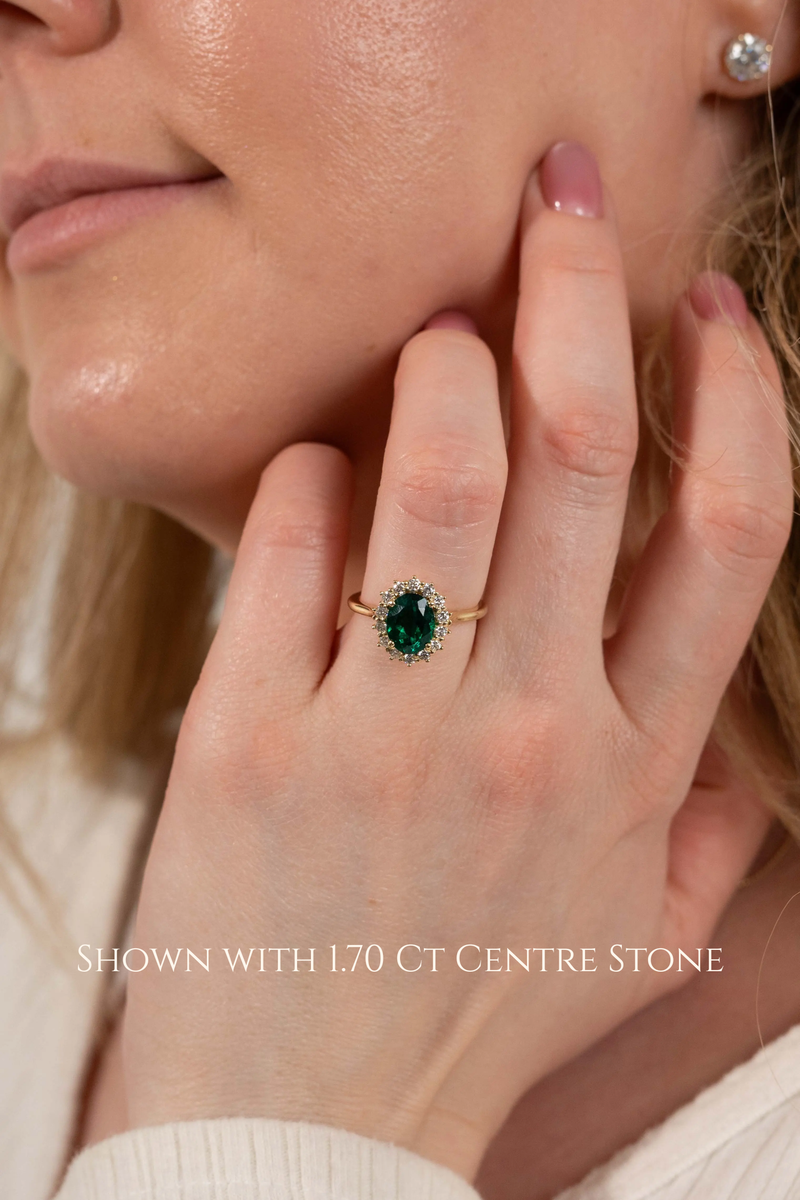
Bella Luna Halo Oval: a 2 carat oval wrapped in a halo of smaller diamonds. Maximum presence, vintage charm.
Every stone IGI certified. Every price itemised. Custom designs welcome. [Explore the 2 Carat Collection →]
FAQs
Is a 2 carat diamond too big for an engagement ring? Bold, but no longer unusual. It's now the fastest-growing size in India. A 2 carat round measures about 8.1mm across, roughly 26% wider than a 1 carat. On most hands it reads "statement," not "chandelier."
How much cheaper is lab-grown, really? For a 2 carat stone in 2026, roughly 90% less than a natural of matching quality, and in some cases 95%. Older pages still quoting "40 to 50% cheaper" are out of date; lab-grown prices have fallen sharply as production scaled.
How much is a 1 carat diamond in India? Lab-grown: about ₹30,000 to ₹70,000 depending on grade and certification. Natural: ₹1.5 lakh and up. Fun implication: a top-quality 2 carat lab-grown ring costs about the same as a mid-grade 1 carat natural stone.
Do lab-grown diamonds pass a diamond tester? Yes. They're carbon crystals identical to mined diamonds and test as diamond. Only specialised lab equipment can identify origin, which is what the IGI certificate documents.
Will a lab-grown diamond hold its value? Honest answer: no diamond, natural or lab-grown, is a financial investment. Resale values disappoint in both categories. Buy a diamond for what it is: something beautiful you'll wear for decades. If investment is the goal, that's what gold is for.
How much is a 2 carat square (princess) diamond? Lab-grown: roughly ₹70,000 to ₹1.2 lakh loose for top grades. Natural: from about ₹6 lakh upward, with the usual fancy-shape discount versus round. Always certified, always itemised.
Prices reflect Indian retail as of September 2026 and move with gold rates, exact grades, and setting choices. For a live quote on any stone, talk to us and we'll show you the full breakdown, line by line.
Ready to find yours?
Browse the collection, or talk to a Varniya expert - we'll help you choose with confidence.